
Photo by VENUS MAJOR on Unsplash
I went to college in New York City with the dream of one day being a published poet who wrote in cafes while drinking cappuccinos and smoking cigarettes. I know, I know, it was the late 80s, early 90s, and all the cool kids were doing it.
Fast forward to today, I drink lattes, don’t smoke anything, and haven’t written poetry in years. Life doesn’t always work out as you planned.
But . . . I did write a book.
Let’s go back a bit.
I started my publishing career in my 20s. I’ve written, edited, project managed, and marketed books. They’ve all been pretty niche non-fiction, and you probably haven’t read any of them. Although I’m proud to say our Pokémon Value Guide, which I researched, co-wrote, and edited, made the NYT Best Sellers list. Should I have lead with that?
Anyway, after a couple of layoffs and a teaching sprint, I went to back to school and graduated with an MFA in Creative Non-Fiction.
My thesis consisted of personal essays and poetry. The poetry had been written years before, I still hadn’t been writing in that genre, but I needed to flesh out the page count. The essays were either revamped from old works or brand new, all shaped by my advisor and classmates’ feedback.
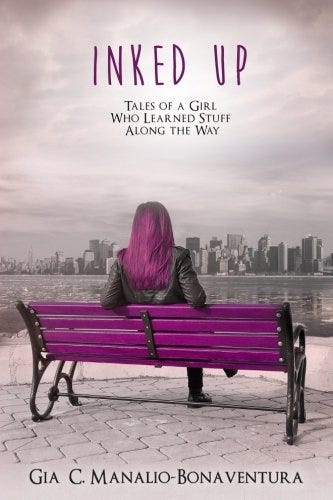
After graduating, I made some changes (names were changed to protect privacy and some parts were removed entirely) and through Kindle Direct Publishing, I self-published Inked Up: Tales of a Girl Who Learned Stuff Along the Way.
Why did I self-publish?
I had a few reasons to take this route, the first being that the essays in the book were extremely personal and I didn’t want anyone to change them. I hired an editor who helped with grammatical issues, but the content remained the same. And with all my talented publishing friends, including my editor, I had everything I needed.
The second is a bit of a lazy excuse. I had just done so much work to complete grad school while working full-time; I just wanted it out there to share with family and friends. I lacked the energy to look for an agent and/or publisher.
(Note: Most traditional publishes require an agented submission. Be sure to check the guidelines before sending in unsolicited work.)
What went wrong?
An acquaintance had just self-published his book and had 500 copies in just a couple months. That seemed easy enough.
But we didn’t start in the same place. Sure, I have a lot of friends who have enjoyed my writing, but he owned a record company and was in a popular goth band. He had a ton of connections, friends, and fans. It didn’t take much more than a few mentions on social media and all of his platforms for his book to sell. Our genres, and therefore audience, were different as well; he wrote queer fiction and I wrote personal essays, so the scope of our audiences were quite different.
Am I telling you not to self-publish?
Absolutely not. Am I telling you that if you self-publish you won’t sell a lot of books? Also, absolutely not.
All I’m saying is that if you do go this route, do your research and manage your expectations.
You can find reliable self-publishing and hybrid resources with a quick Google search.
Looking back . . .
If I had to do it again with this particular book, I’d probably do the same thing. Sure, I would have liked to sell more, but that was never really my reason to publish it in the first place. I wanted to share my stories with the people I loved. To say it “went wrong” isn’t accurate.
But to think an audience of people who didn’t know me personally would buy the book,
Did I secretly hope I would sell millions of books to people who didn’t know me and wanted to hear my personal stories that very likely didn’t relate at all to them? Of course I did.
That future dream girl writing to-be-published works in a NYC cafe still lives in my soul.
That said, when I write my next one, which I will do some day, I’d go the traditional route. I’ll put the manuscript and its future in the publishing house’s hands and watch them work the magic.
Don’t get me wrong. Niche is great. Write for you and not your audience and all that. But once again I say, manage your expectations.
Then when you do better than expected, it’ll be amazing.
How about you?
I would love to know about your publishing experience. What route do you recommend? If you self-published, what tips do you have for selling more than a handful? Please help a fellow writer out!

 Hi, I'm Gia.