About the Time I (almost) Got Scammed by a “Book Reviewer”

Photo by Markus Winkler on Unsplash

If you read my stuff or you know me personally, you know that (1) I wrote a book that I didn’t expect to be widely read, and (2) I work in publishing.

What you may not know is that a large part of my job is pitching books to influencers who may want to review them, which if nothing else, makes me very aware of how the process works.

Enter my ego.

The email . . .

You can imagine my excitement when I opened my email one morning to find someone requesting to have her team review my book. *Jennifer* had me at the subject line: “When cringe turns into courage and why Inked Up deserves more eyes than it has.”

*For the purpose of this article, I’m referring to Jennifer as female since it typically is a female name. That said, I don’t believe gender is binary. And the name is beside the point because I’m pretty sure no real Jennifer was involved and the name was changed to protect the not-so-innocent.*

Jennifer then went on to talk about specific points in my book that really sounded like she had read it. She told me she has a team of reviewers that she’d love to share the book with, and they fully trust her recommendations. Jennifer also assured me she didn’t charge the authors.

My ego sucked it all up.

Now let’s look at the red flags:

  • The email came to my work email (which I reasoned away as my personal email is too hard to find — even though I now remember I have a website). I did forward it and all communication was through my personal Yahoo account.
  • The email came from a Gmail account.
  • At least in my (extensive) experience, people don’t pitch authors to review their books, it’s usually the other way around or the reviewer just reviews it.

Ego in charge . . .

My first inclination was to look up the name of the reviewer, like anyone would do. And wouldn’t you know, there were a couple each of reviewers and authors of that name.

And there are legit paid services out there.

I wanted to know more. So, when she asked what I wanted readers to come away with after reading my book, I didn’t hesitate to answer with a response that was already public.

And then . . .

She wrote back.

The response came quickly. It addressed what I had written about motivation and then pretty much rehashed exactly what the first email said. Jennifer said that if I were interested, she would explain the process to me in a subsequent email.

So again, I asked for more information and this time I mentioned that I couldn’t believe a service like this wouldn’t have some sort of fee.

The next response came quickly in which she said she appreciated and understood my question but assured me that she doesn’t charge authors. There is, however, a cost for a “reader appreciation token.” What that was I could only guess because she certainly wasn’t explaining it to me at that point.

She also requested a PDF of the book.

Of course, I asked for more info again and if I could send the eBook rather than a PDF. Since I self-published through Amazon KPS, I could send the digital version with little effort.

At this point my ego was still running the show. I mean, I could spend like $100 for the 122 reviews she was promising me . . .

Let’s look at the red flags:

  • Once I thought about it, I realized that everything she said about the book was just a rehash of my author bio.
  • I’ve worked with AI enough in my professional life to pick up on what is very likely AI writing, and this was definitely that.
  • Publishers never give out PDFs of books. The published eBook, yes, but an actual PDF doc that can be manipulated, no.
  • If she didn’t charge the authors, how was there a reader appreciation token?

“You’re drunk, ego, go home” — My brain.

The next email came with prices and a full explanation of how things worked. That’s when my brain totally took over.

I would pay a crew leader who would distribute the appreciation tokens to the readers. So it was “technically true” that Jennifer herself wasn’t charging for the reviews. You know, if any of it was even remotely true.

The appreciation tokens went like this. I could start with as little as 10 readers for a mandatory “appreciation” of $10 per reader and go as high as 100 reviews for the mere “appreciation” of $25 per reader.

They would not be considered paid reviews because the cost was more of a tip (albeit required) and they were going to be authentic with no promise of being positive.

More red flags:

  • That ridiculously high mandatory appreciation token — not fee — token.
  • I’ve solicited paid reviews and I’ve never once asked them to be anything but completely authentic and honest.
  • Not once in any of the emails did she specify any credentials that could be verified.
  • The same stiff, repetitive language.
  • The emphasis on the funds not going through her personal account.

The end . . . or is it?

I wanted to write something snarky back and while it would have felt pretty good, it wouldn’t have done any good. I decided not to respond at all.

But within hours, a follow-up arrived. I responded, politely declining in just a few words.

But then . . .

Another one came. This one said she respected my decision, but could I let her know why I was passing so that she could figure out a way to work with me?

I responded with this, which I hoped was not enough info to make the scam better but enough for her to leave me alone (before I had to block them):

These are clearly paid reviews, regardless of if they are guaranteed positive or not, as well as requiring mandatory high-priced “appreciation tokens” is not an industry practice. So, while technically you aren’t charging the author, you are.

Plus, you provided absolutely no credentials that could be verified.

Overall, this seems like a pretty big scam. But it did make my ego feel good for a quick minute.

The next day I received another email saying she understood how I felt and appreciated my honestly. That said, she assured me that this was the perfect time to promote the book and she really could help. She’d love to send me examples of authors her crew had worked with. Because what’s the harm in clicking links or downloading things from an email that’s likely a scam.

And to nobody’s surprise, the email was full of the same, repetitive language.

It’s been a few days . . .

I haven’t heard anything since that last email and I’m not sure I will. I have found similar scams with similar names reported online, which I probably would have found had I searched the right terms in the beginning.

The email did exactly what it was intended to do: it stroked my ego. And while my brain understands that Inked Up will never be a NYT best-seller and this was definitely attempted fraud, my ego still holds out hope.

What I Got Wrong When I Self-Published

Photo by VENUS MAJOR on Unsplash

I went to college in New York City with the dream of one day being a published poet who wrote in cafes while drinking cappuccinos and smoking cigarettes. I know, I know, it was the late 80s, early 90s, and all the cool kids were doing it.

Fast forward to today, I drink lattes, don’t smoke anything, and haven’t written poetry in years. Life doesn’t always work out as you planned.

But . . . I did write a book.

Let’s go back a bit.

I started my publishing career in my 20s. I’ve written, edited, project managed, and marketed books. They’ve all been pretty niche non-fiction, and you probably haven’t read any of them. Although I’m proud to say our Pokémon Value Guide, which I researched, co-wrote, and edited, made the NYT Best Sellers list. Should I have lead with that?

Anyway, after a couple of layoffs and a teaching sprint, I went to back to school and graduated with an MFA in Creative Non-Fiction.

My thesis consisted of personal essays and poetry. The poetry had been written years before, I still hadn’t been writing in that genre, but I needed to flesh out the page count. The essays were either revamped from old works or brand new, all shaped by my advisor and classmates’ feedback.

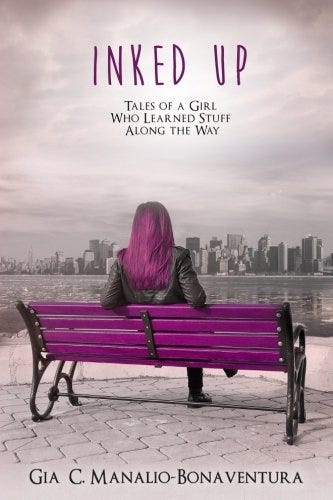
After graduating, I made some changes (names were changed to protect privacy and some parts were removed entirely) and through Kindle Direct Publishing, I self-published Inked Up: Tales of a Girl Who Learned Stuff Along the Way.

Why did I self-publish?

I had a few reasons to take this route, the first being that the essays in the book were extremely personal and I didn’t want anyone to change them. I hired an editor who helped with grammatical issues, but the content remained the same. And with all my talented publishing friends, including my editor, I had everything I needed.

The second is a bit of a lazy excuse. I had just done so much work to complete grad school while working full-time; I just wanted it out there to share with family and friends. I lacked the energy to look for an agent and/or publisher.

(Note: Most traditional publishes require an agented submission. Be sure to check the guidelines before sending in unsolicited work.)

What went wrong?

An acquaintance had just self-published his book and had 500 copies in just a couple months. That seemed easy enough.

But we didn’t start in the same place. Sure, I have a lot of friends who have enjoyed my writing, but he owned a record company and was in a popular goth band. He had a ton of connections, friends, and fans. It didn’t take much more than a few mentions on social media and all of his platforms for his book to sell. Our genres, and therefore audience, were different as well; he wrote queer fiction and I wrote personal essays, so the scope of our audiences were quite different.

Am I telling you not to self-publish?

Absolutely not. Am I telling you that if you self-publish you won’t sell a lot of books? Also, absolutely not.

All I’m saying is that if you do go this route, do your research and manage your expectations.

You can find reliable self-publishing and hybrid resources with a quick Google search.

Looking back . . .

If I had to do it again with this particular book, I’d probably do the same thing. Sure, I would have liked to sell more, but that was never really my reason to publish it in the first place. I wanted to share my stories with the people I loved. To say it “went wrong” isn’t accurate.

But to think an audience of people who didn’t know me personally would buy the book,

Did I secretly hope I would sell millions of books to people who didn’t know me and wanted to hear my personal stories that very likely didn’t relate at all to them? Of course I did.

That future dream girl writing to-be-published works in a NYC cafe still lives in my soul.

Shameless self-promotion

That said, when I write my next one, which I will do some day, I’d go the traditional route. I’ll put the manuscript and its future in the publishing house’s hands and watch them work the magic.

Don’t get me wrong. Niche is great. Write for you and not your audience and all that. But once again I say, manage your expectations.

Then when you do better than expected, it’ll be amazing.

How about you?

I would love to know about your publishing experience. What route do you recommend? If you self-published, what tips do you have for selling more than a handful? Please help a fellow writer out!

Got writer’s block? Check these out.

Photo by Ryan Snaadt on Unsplash

I can’t write.

I mean, I can write. I have two degrees in creative writing and have written professionally for decades.

But when it comes to writing on my own, I have a horrible time with writer’s block. This is a relatively new thing in the past few years, and I think life and all its responsibilities take a toll on creativity.

But when I decide I’m tired of my own excuses (maybe they aren’t all excuses, but more of my feeling bad about writing), I look for resources that can help. Let me tell you about some of them.

There’s a class for that

I love school. I love classes and ever since graduation, I’ve taken a variety of them. Having deadlines and accountability helps me tremendously. So, if they help you and you have a little extra time and money, here are a few I suggest.

Writing Workshops: Most of the classes are online but they also offer international writing retreats and even an IndieMFA program — all from professional writers.

Gotham Writers Workshop: Gotham offers in-person, Zoom, and independent programs taught by accomplished faculty.

On the page

Writing books are great if you want flexibility and have more self-discipline than I do. They come in different formats from inspirational to workbook. Some of my favorites include:

Bird by Bird by Ann Lamott

On Writing by Stephen King

Writing Down the Bones by Natalie Goldberg

The Artist’s Way by Julia Cameron

Save the Cat! Writes a Novel by Jessica Brody

Right now I’m super excited about these: Write a Romantasy and Write a Dystopian Novel, both from Erik Patterson, who you may know as YourDailyWritingPrompt on TikTok. Coming soon, and the one I’m most excited about, is Write a Horror Novel.

Erik brings his quick wit and professional insights to these pages full of tips, encouragement and prompts. He’s fantastic.

In the cards

Are you creative but also into Tarot and magick? Check these out:

Tarot for Creativity by Chelsey Pippin Mizzi

Lessons from the Empress by Cassandra Snow and Siri Vincent Plouff

Magic Maker by Pam Grossman

The Writer’s Oracle by Alexadra Rowland (not magic, but still excellent)

Tell me more

What are your go-to resources when you need some writing inspiration? Let me know in the comments! I’m always looking for suggestions, please help a fellow writer out!